

 |
| La Pedera by Gaudi |
I had never heard of Antoni Gaudi until just recently when I started talking to people about Barcelona. His name kept coming up in the same sentence with Sagrada Familia. I had no clue what people were talking about. Now, I do and I have to say, I am in LOVE with Gaudi. Honestly, if I had been introduced to Gaudi back when I was in high school and college, I really think I would be an architect today. His style is whimsical, colorful and brilliant! He is known as one of Catalans famous architects and the leader of Catalan modernist movement.
Gaudi was born in 1852 and spent his childhood in Reus, a village found in the province of Tarragona in region of Catalonia, Spain. As a young child he was very ill with rheumatism. He had a deep appreciation for nature and spent many hours as a young child outside studying trees and plants. Many of his designs are influenced by the structure of trees and plants. He was, also, a very religious person.
By the age of 16, Gaudi had moved to Barcelona to begin studies for a career of teaching. By 1876, he was studying to be an architect. He wasn’t the best of students, often flunking courses. He graduated in 1878 and when given his diploma by the head of the director of the Barcelona Architect School, a comment was made along the lines of graduating either a fool or a genius! I believe that Gaudi proved to be a genius by his remarkable works!
Gaudi has several buildings throughout Barcelona. Many are recognized as UNESCO World Heritage Sites. I visited the Park Guell, the cathedral Sagrada Familia (Holy Family) and Casa Battlo, all which he designed. I walked past La Pedera and Palau Guell. Unfortunately, time didn’t allow for more visits to the interior of these buildings or to discover more of his work throughout Barcelona.

The Park Guell is also on the UNESCO World Heritage Site. At the entrance are two buildings in his whimsical design, decorated with colorful mosaic patterns. The gate reminded me of palm leaves. As you enter, you can see a terrace supported by tall pillars. Every inche is covered with mosaics. There are burst of suns, animals of lizards and heads of various animals, all colorfully decorated.

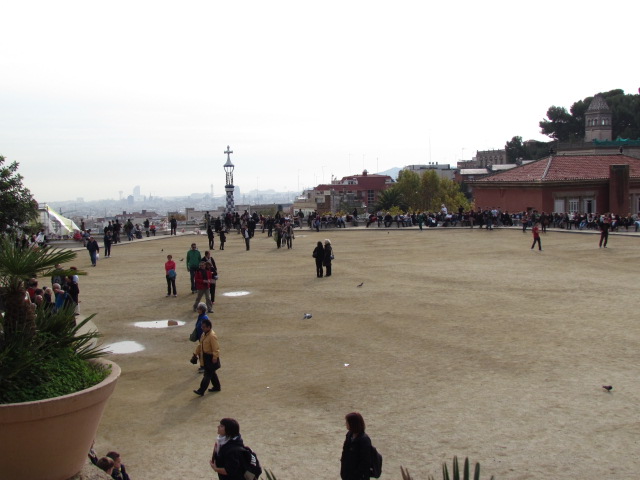
This is the stairway to enter the park. In the center is an area of plants and on the first level, a large mosaic lizard. It was quite a feat to get a picture of it without everyone standing near it or sitting on it for this picture! It is a very busy photo stop. The columns is a support for a plaza area on top of it that gives you a view of the city.



There is absolutely nothing that can prepare you for your first viewing of this magnificent creation. It takes your breath away when you walk in! My pictures do not do justice to the beauty of this cathedral. In all, there are 56 columns. Gaudi once said “Nothing is invented; it’s written in nature.” These columns represent trunks of trees with branches, leaves and knots. The design and placement of the windows gives you the feeling that you are standing under a canopy of leaves that allows the sunlight to filter through. The highest columns are 72 ft tall and the shorter ones are 36 ft. They are in various colors of brown clay, gray granite and dark-gray basalt. In the center of the church there are four columns of red porphyry, a strong volcanic rock used by the early Romans and Greeks. These are support for the 200 ft high ceiling!
The nave is in the shape of a cross. It is 300 ft long and 200 ft wide. When it is finished, the church will be 48,000 sq ft and will be able to accommodate 8,000 worshippers. The choir stall, which is suspended above the nave, can seat 1,000 people. Currently, there is one organ but the design is to have four.

Many of the windows are of clear glass but slowly, they are being replaced with stain glass.

Currently, two of the three facades are finished. As you enter, you pass under the Passion Facade that tells the story of Christ’s crucifixion. The statues are very plain and austere, so unlike Gaudi’s style. I guess he wanted us to feel the sadness and pain that Christ experienced on that day.

On the opposite side of the building is the Nativity Facade. It tells the story of Jesus’ birth and life. As you can see, it has a much different appearance than the Passion one. This is about life…nature, trees, plants and animals are used in telling the stories. It is more in Guadi’s whimsical style that I so love.
The front entrance has yet to be completed. It is referred to as the Glory Facade and will have a grand staircase leading to the doors. This facade will tell the story of death, how one’s soul passes through the Last Judgement into heaven to have ever lasting life with God.

You can go up in the tower, which I did. It is a narrow elevator that fits only 6 people. Once at the top, you cross over to a second tower, for great views of Barcelona and the ocean. Then, you climb down hundreds of spiral stairs. It isn’t a side trip for the faint of heart!


 |
| Model of completed Cathedral |


